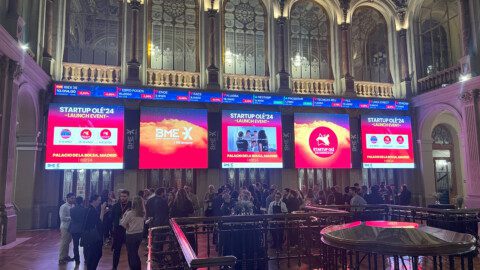
South Summit Madrid 2026 opened at La Nave with a message Europe has heard for years, but rarely with this level of pressure behind it: founders cannot scale globally if the continent keeps behaving like 27 separate markets.
Under the theme AI Convergence, the summit gathered more than 600 international speakers, over 20,000 attendees, around 4,900 startups and more than 2,000 investors, family offices, venture builders, corporates and institutions.
The numbers were strong. The agenda was sharper. Artificial intelligence was not treated as another software category. It was discussed as industrial policy, defense capability, mobility infrastructure, education reform, startup acceleration, capital strategy and geopolitical leverage.
María Benjumea, president and founder of South Summit, opened with a clear warning. AI is no longer an isolated technology. It is becoming a transversal force that changes industries, business models and strategic capabilities. She also argued that a startup born in Spain should be able to think of Europe as its natural home, not as 27 different borders.
That line cut through the usual event optimism. It named the problem most European founders know too well: the talent exists, the science exists, the ambition exists, but the operating environment still slows companies down.
South Summit’s strongest conversations were not about inspiration. They were about infrastructure: capital, procurement, digital identity, defense, AI adoption, corporate access and cross-border scale.
AI Convergence.
Sebastian Thrun, founder of Google X and one of the central figures in modern AI, gave the summit one of its clearest founder messages: physical AI will be won through software. The companies that lead in robotics, autonomous systems and intelligent infrastructure will not simply be the ones with the best machines. They will be the ones with the software capable of managing, improving and coordinating those machines.
He also pushed back against defensive thinking. In his words, the point is not to protect yourself from the AI wave, but to learn how to use it before it passes over you.
That is easy to say from a keynote stage. It is harder inside a company with old systems, limited data, overstretched teams and customers who still expect fast answers.
This is where the conversation becomes practical for companies like Lovi.ai, a GLOBALS Accelerator startup building AI agents for customer service and sales. Lovi describes itself as an all-in-one AI platform to automate customer support and sales across multiple channels, with generative AI agents designed to resolve inquiries instantly and operate across customer touchpoints.
That places Lovi inside one of the clearest near-term AI use cases for growing companies: customer interaction. Support teams are expensive to scale. Sales teams lose leads when response times are slow. Small companies often cannot afford 24/7 service, multilingual coverage or instant qualification across web, WhatsApp, phone and social channels. AI agents do not remove the need for human judgment, but they can reduce repetitive work, shorten response times, qualify demand and give human teams more context before handover.
This is the practical side of AI Convergence. Less theatre. More workflow. Fewer vague claims about transformation. More measurable impact on cost, speed and customer experience.
Europe’s problem is not talent. It is drag.
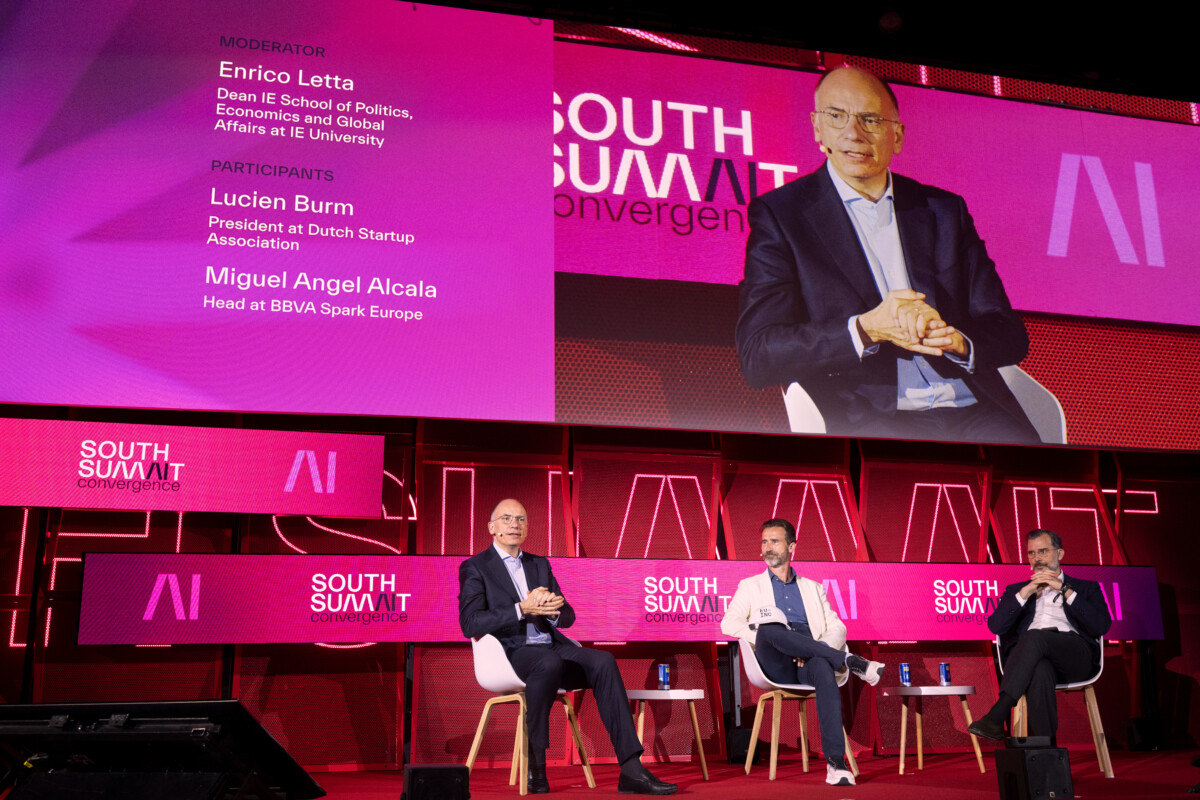
Enrico Letta, former Italian prime minister and dean at IE School of Politics, Economics and Global Affairs, framed the European problem with precision. Completing the single market is essential if European startups are going to grow and compete globally.
He pointed to the European roadmap “One Europe, One Market,” which includes more than 40 legislative initiatives across capital markets, energy, digital infrastructure and industrial policy. His proposed horizon was 2027 for a genuinely integrated European market.
For founders, this is not policy theatre. It is the daily cost of growth.
A startup expanding from Spain to France, Germany, Italy or the Nordics often has to rework hiring, legal, tax, compliance, data, payroll, sales contracts and investor conversations country by country. That friction punishes speed. It also punishes smaller teams, which are exactly the teams Europe claims it wants to help.
The US gives founders a large domestic market. China gives selected technology companies scale, state coordination and industrial depth. Europe gives founders talent and credibility, then often asks them to navigate complexity before they have the headcount to survive it.
That is why digital public infrastructure should not be treated as a side topic. It is part of startup competitiveness.
The summit in one table
| What happened | Why it counts for founders |
|---|---|
| South Summit Madrid 2026 gathered more than 20,000 attendees, around 4,900 startups, over 2,000 investors and 600 international speakers | The event has become a serious marketplace for capital, visibility and partnerships. |
| The Startup Competition featured 100 finalists selected from more than 4,500 applications across 110 countries | Finalist status is valuable, but only if founders convert it into meetings, press, customers and investor follow-up. |
| Spain announced €162 million in aid for dual-use technologies, focused on AI, semiconductors and robotics testing infrastructure | Public capital is moving toward strategic technologies with both civilian and security applications. |
| Sebastian Thrun argued that leadership in physical AI will depend on software, not hardware | AI advantage is shifting toward teams that can orchestrate intelligent systems, not just build devices. |
| Enrico Letta pushed for a completed European single market by 2027 | Europe’s startup problem is not only funding. It is fragmentation. |
| NATO DIANA, Airbus, Hispasat and defense tech founders joined the same startup conversation | Defense tech has moved from the edge of the ecosystem into the main room. |
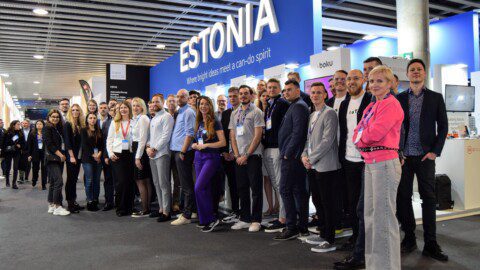
| Estonia’s e-Residency now reports 140,000+ e-residents and 41,800+ companies founded by e-residents | Digital company infrastructure is becoming part of the founder stack for cross-border teams. (e-Residency) |
e-Residency belongs in the founder toolkit, but it should be explained properly.
Estonia’s e-Residency offers a useful case study in what founder-friendly digital infrastructure can look like. It allows digital entrepreneurs to establish and manage an EU-based company online from anywhere in the world.
The official e-Residency dashboard reports more than 140,000 e-residents and over 41,800 Estonian companies established by e-residents. The program’s official site says entrepreneurs can register an EU business online without relocating.
For international founders, remote teams and cross-border service businesses, that is meaningful. e-Residency can help with company administration, digital signing, access to Estonian public and private e-services and working with service providers through the e-Residency Marketplace.
It is not a shortcut around substance. It does not automatically solve banking, tax, residence, fundraising or product-market fit. Founders still need advice, customers and a real business. But when South Summit speakers complain that European startups face too many borders, Estonia’s model offers a concrete answer: make company building easier to operate online.
The program also has economic weight. Estonia reported that e-residents founded 5,556 companies in 2025, a 15% increase from 2024, and generated nearly €125 million in direct state revenue from e-residents and the Estonian companies they created.
For GLOBALS, e-Residency fits naturally into the founder support layer. It is not a slogan. It is infrastructure founders can evaluate when building across borders.
Building across borders? Estonia has the paperwork covered.
Porto Alegre showed what founders want: access, speed and fewer borders in the way. e-Residency of Estonia, a Club GLOBALS partner, helps international entrepreneurs explore how to run a trusted EU company online, sign documents digitally and operate with less administrative drag.
Meet the e-Residency representative
Defense tech entered the main room.
One of the most important shifts at South Summit Madrid 2026 was the presence of defense tech as a mainstream startup topic.
NATO DIANA, Airbus, Hispasat, Spain’s Ministry of Defense, startups and international funds joined a dedicated vertical on Defense & AI, focused on AI, dual-use technologies, deep tech and Europe’s strategic autonomy.
Jyoti Hirani-Driver, COO of NATO DIANA, said the wars in Ukraine and Iran have shown that technological adaptation is not an abstract idea, but a necessity. She also said Europe is beginning to move away from acting as separate ecosystems and toward operating more coherently.
Airbus president Amparo Moraleda gave the room one of its most quoted figures: around 80% of European defense spending ends outside Europe. Her conclusion was blunt. Europe needs to spend more, spend better and spend inside Europe.
Pedro Duque, president of Hispasat, added the space layer. Communications, Earth observation, connectivity and orbital capabilities have become critical assets for defense, autonomy and resilience. The war in Ukraine showed how deeply intelligence and communications depend on space infrastructure.
Defense tech used to be a difficult category for many European founders. Procurement cycles were slow. Investors were cautious. Public buyers were hard to reach. Talent sometimes avoided the sector. That is changing.
The new vocabulary is dual-use: technologies with civilian and strategic applications. AI, space tech, cybersecurity, quantum, energy resilience, sensors, robotics and secure communications are no longer separate from Europe’s competitiveness agenda. They are part of it.
Miguel Acosta of Arquetipo captured the founder obstacle well. Defensive sovereignty is not only about having capability. It is about having the technology and knowing what to do with it. He also warned that bureaucracy can slow entrepreneurs and weaken that sovereignty.
This is one of the most important lessons from the summit: Europe cannot regulate its way into sovereignty if it does not also build, buy and scale.
This is also where the conversation connects naturally with the Horizon Deep Tech Summit, a GLOBALS partner and a key meeting point for Europe’s deep tech ecosystem. If South Summit showed that defense, AI, space, quantum, cybersecurity and industrial resilience are moving into the startup mainstream, Horizon is one of the places where that discussion can go deeper. The summit brings together founders, investors, institutions and corporate leaders in Madrid for three days focused on strategic visibility, meaningful conversations and real business opportunities.

The King’s visit gave the startup competition institutional weight.
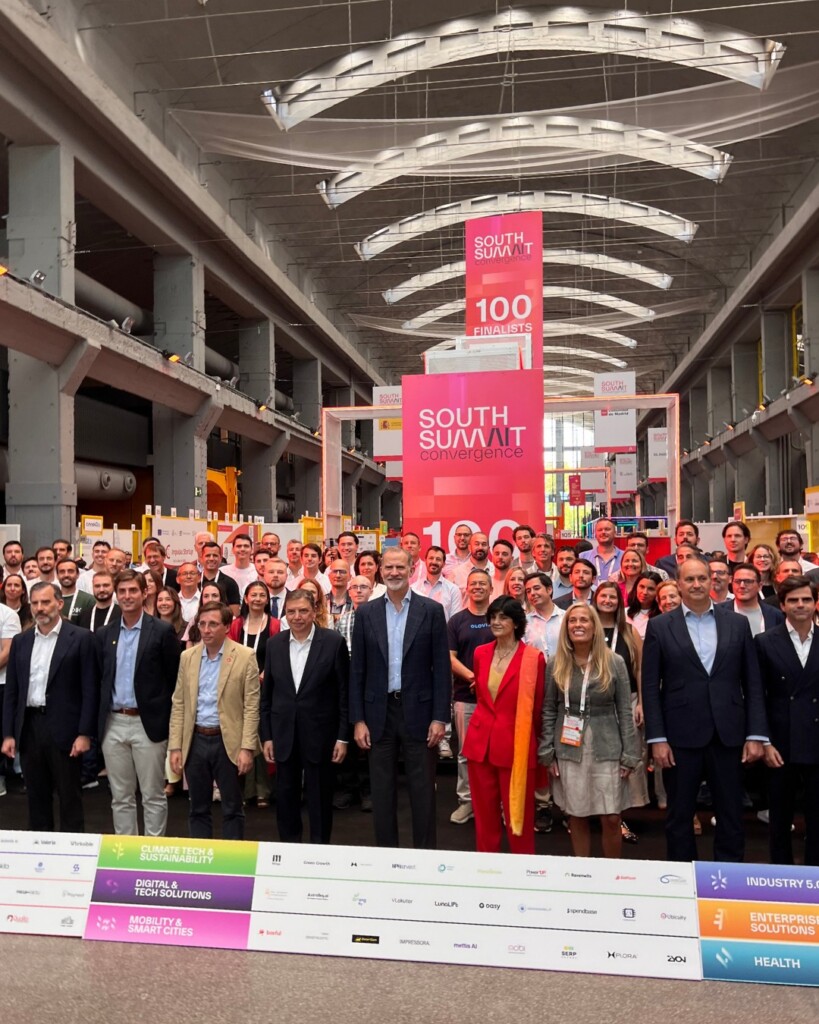
King Felipe VI’s visit on June 4 gave the startup competition a different texture. He listened to pitches from some of the 100 finalists, selected from more than 4,500 applications across 110 countries. He also visited the AI Forum, where participants showed working AI prototypes created during the session.
The visit mattered because it placed founders in front of institutions, investors and media at the same time. That combination is rare. It changes the pressure of a pitch. The founder is not only selling a product. They are being read as part of a national and European innovation story.
South Summit’s historical numbers explain why the competition carries weight. Across fourteen previous editions, the platform has gathered more than 42,500 startups. More than 1,500 Startup Competition finalists have gone through the program, with an 85% survival rate and more than $20.5 billion raised.
Those numbers should not make founders romantic. They should make them disciplined. A finalist badge is useful only when it becomes follow-up: investor meetings, customer introductions, partner conversations, press assets, demo recordings, founder interviews and a sharper commercial story.
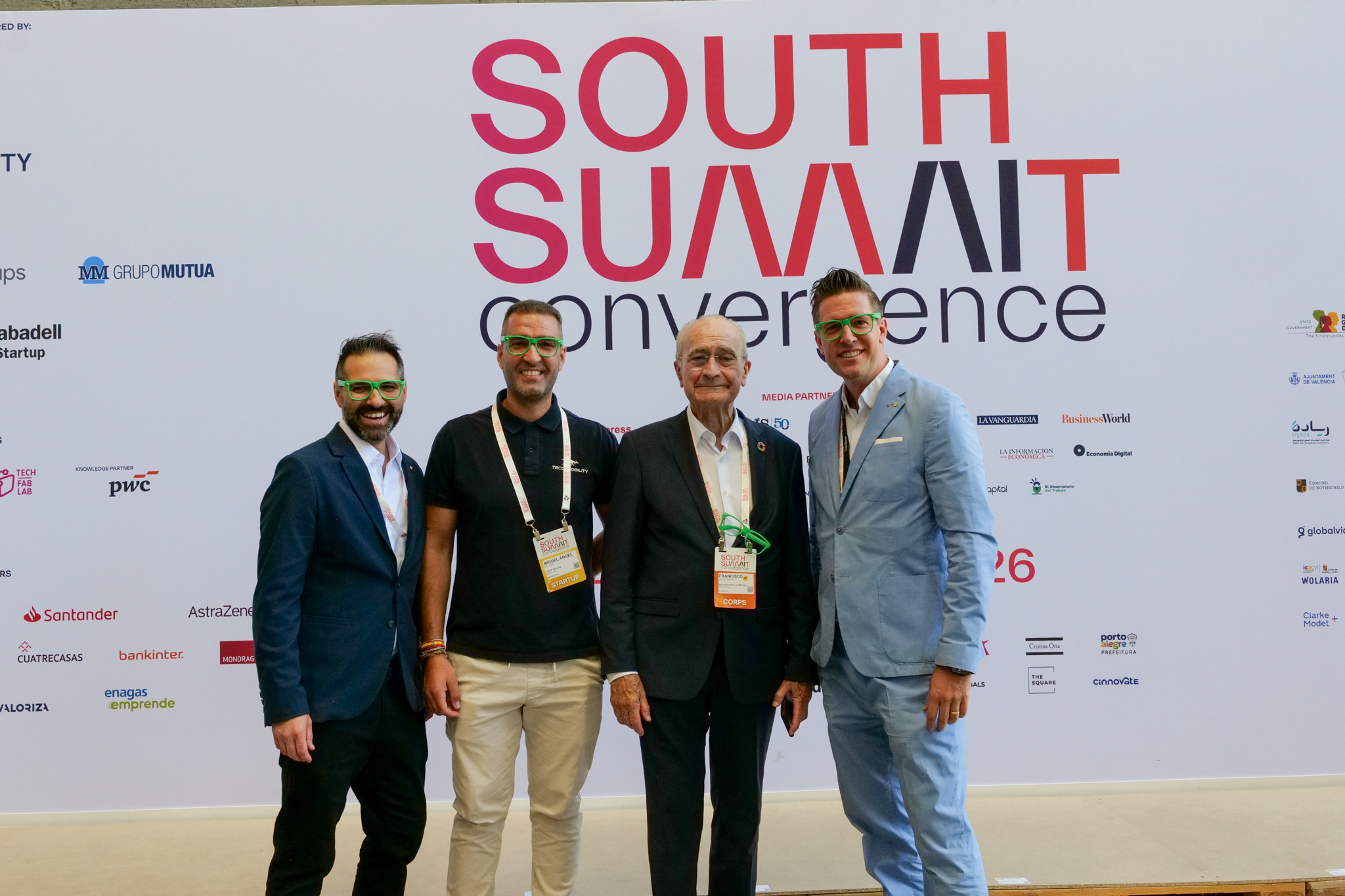
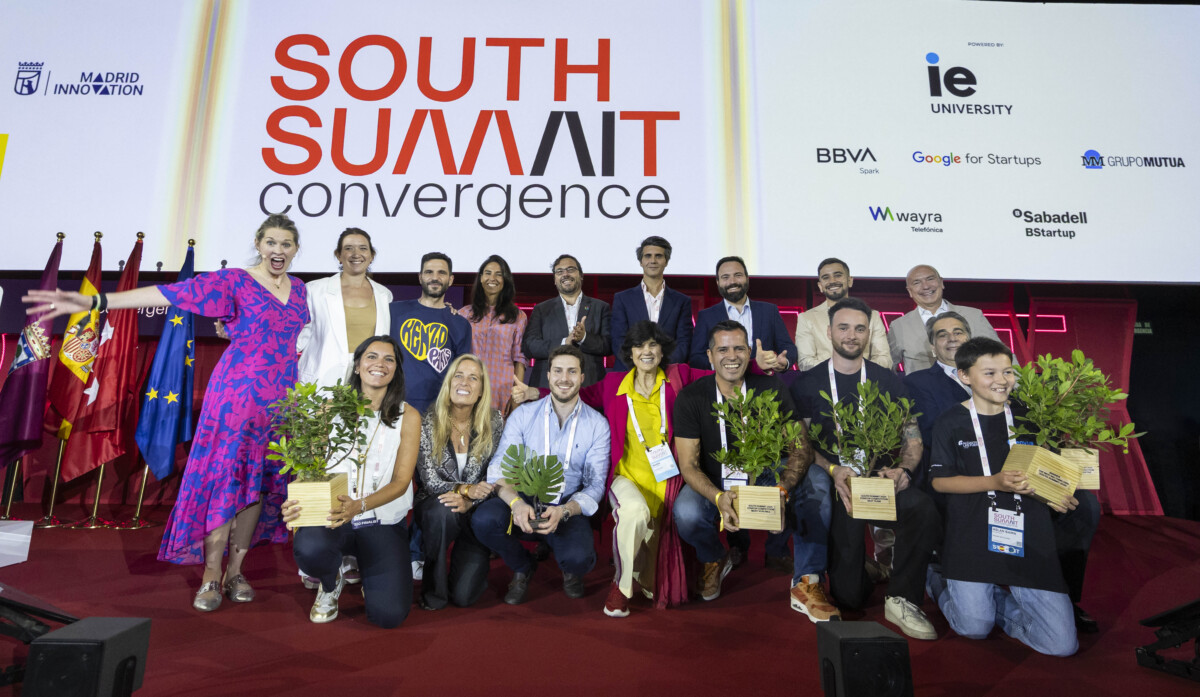
The winners showed where investors are looking.
The awarded startups offered a useful map of where business interest is moving.
From Barcelona, Macadam won the Consumer vertical with an app that rewards users for walking and staying active. Mitiga won Climate Tech & Sustainability with AI and climate models that help companies analyze and reduce climate risks. Secrets Vault won Trust Tech & Data with post-quantum technology that creates security keys from images to improve data and user protection.
From Madrid, Altum Sequencing won Health with advanced blood analysis designed to detect cancer relapse earlier and less invasively. Floatech, based in Getafe, won Industry 5.0 with technology for next-generation silicon anodes for more efficient batteries.
The pattern is clear.
Health is moving toward earlier detection and less invasive diagnostics. Climate tech is becoming risk infrastructure for companies exposed to climate volatility. Trust tech is being pulled forward by post-quantum security concerns. Industry 5.0 is being shaped by batteries, materials and automation. Consumer still has room when behavior change is measurable.
For founders, the lesson is uncomfortable but useful. “Innovative” is too vague. Investors want category, urgency, proof and timing. What pain do you remove? Who pays? Why now? Why your team? What becomes cheaper, faster or safer because your company exists?
Spain is becoming a tech beacon. Valencia is where the next deals can happen.
After South Summit Madrid, the bridge continues at Valencia Digital Summit, one of Southern Europe’s most relevant stages for startups, investors, corporates and tech leaders. Through Club GLOBALS, founders and partners can explore opportunities to attend, speak, sponsor or build visibility at VDS.
The Kids Competition was small, but not soft.
The South Summit Kids Competition was won by Alcaste-Las Fuentes from La Rioja for the second consecutive year. Their project, Bioward, is an intelligent camera that uses AI and air sensors to detect viruses quickly.
It would be easy to treat this as a sweet education story. It deserves more attention than that.
The competition asked students to design, develop and defend business projects before a jury of entrepreneurs. It emphasized creativity, collaboration, communication, argumentation and the ability to identify real challenges with sustainable solutions.
That is ecosystem building at the earliest stage. Europe often speaks about producing more founders, but founder formation does not start at a venture capital office. It starts when young people learn how to observe a problem, build a first version, explain it clearly and accept hard questions.
A strong startup ecosystem needs the full ladder: children, students, first-time founders, accelerators, corporates, investors, institutions and media. South Summit showed all of those layers in the same week.
What founders should take away.
South Summit Madrid 2026 gave founders a practical and slightly unforgiving message. AI must be operational, not ornamental. Europe’s fragmented market is still a competitive liability. Defense tech and dual-use startups are entering the center of the investment conversation.
Digital sovereignty is becoming a business issue, not just a policy debate. Startup finalist status must be converted into meetings, customers, media and investor conversations.
e-Residency belongs in the toolkit for founders who need to operate across borders, but it should be assessed with proper legal and tax advice. Community builders win when they connect visibility with execution.
The summit did not present a finished European startup strategy. It exposed the work still missing. Europe has talent, science, industrial assets, public capital and a growing appetite for strategic technology. It still needs faster capital, cleaner cross-border rules, stronger digital infrastructure and more serious follow-up after the event lights go down.
For founders, the message should be clear: do not leave a summit with only photos and LinkedIn posts. Leave with a sharper narrative, warmer investor conversations, stronger partner targets and a concrete plan for the next 30 days.




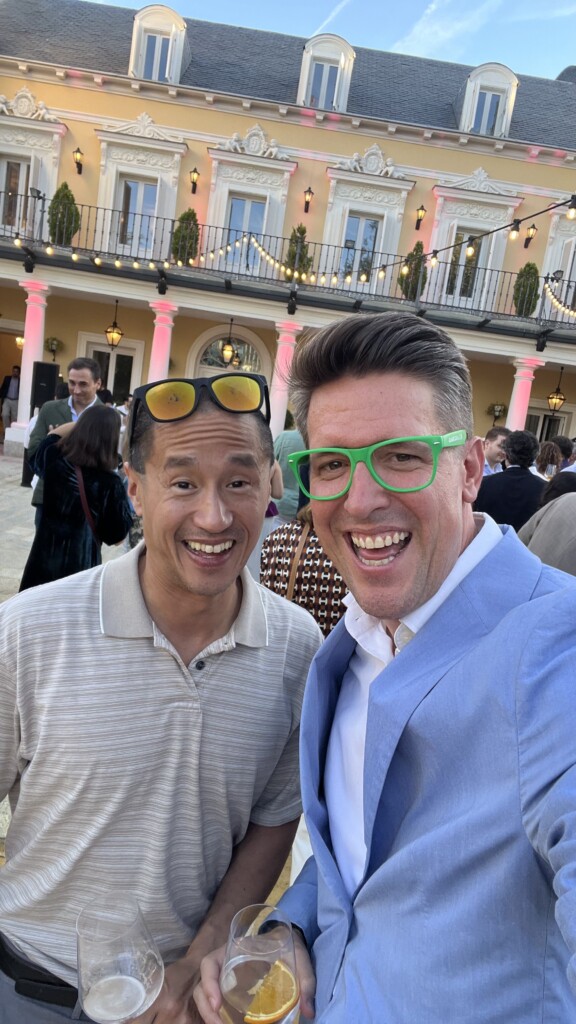
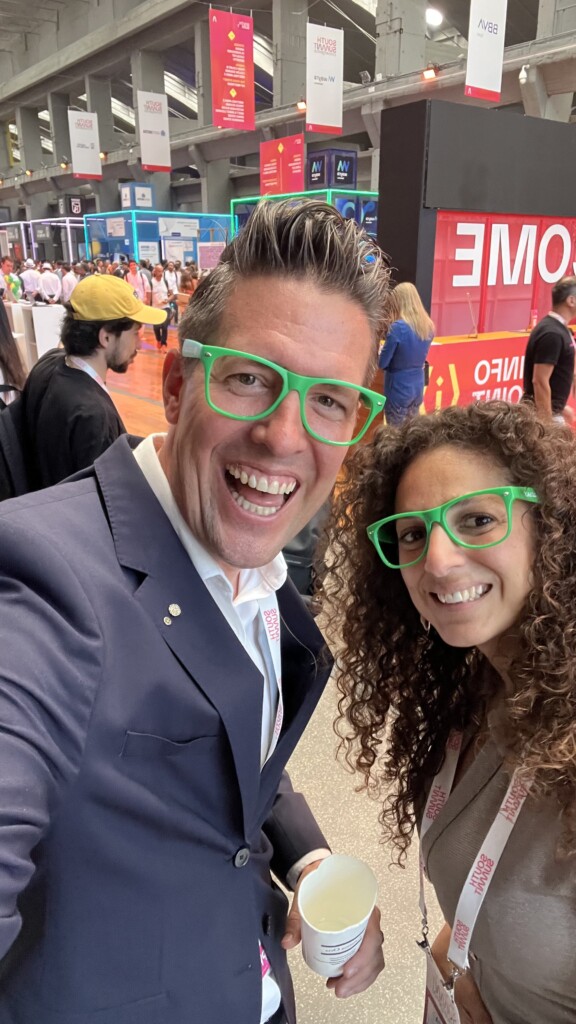


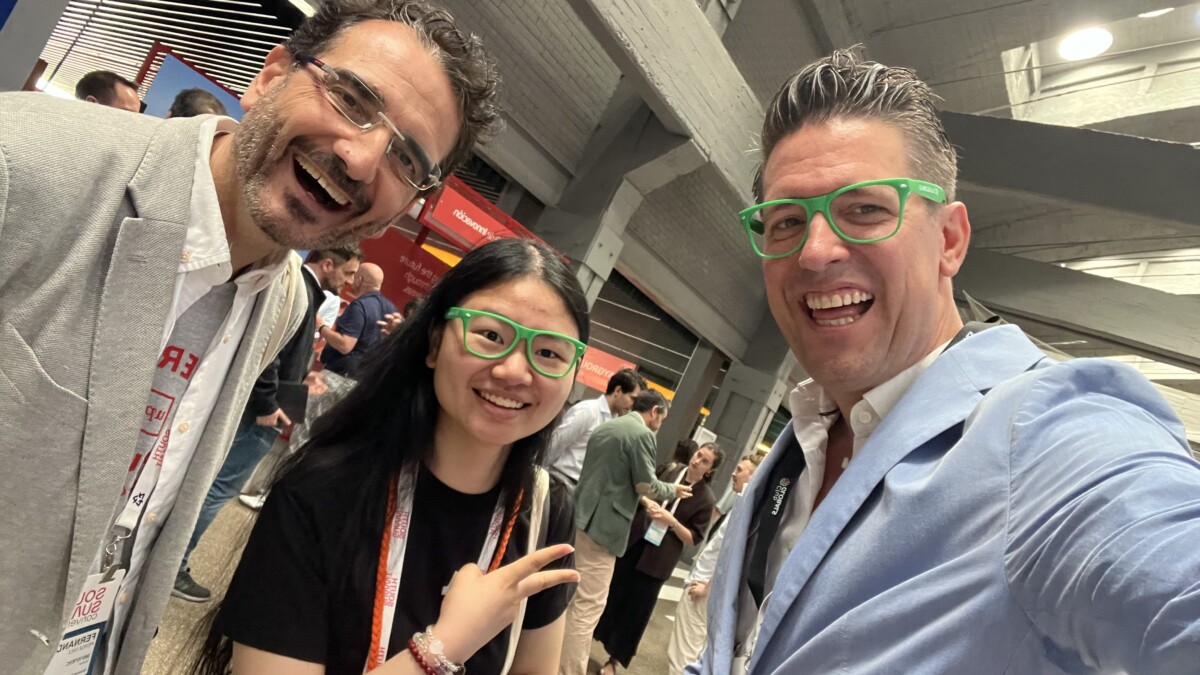




Are you ready for GLOBALS on Tour Berlin?
GLOBALS On Tour is a global networking series designed to connect startups, investors, and industry pioneers ahead of the GLOBALS Tech Festival in Barcelona. The America journey kicked off in Porto Alegre, while the European tour started in Malta in a series of networking events leading up to the festival on February 28, 2027, in Barcelona!
📍 Berlin – April 22, 2026
🎟️ Join Club GLOBALS for Exclusive Access
🔎 Explore More Events: GLOBALS Event Agenda
Hop on the tour — See you in Berlin!