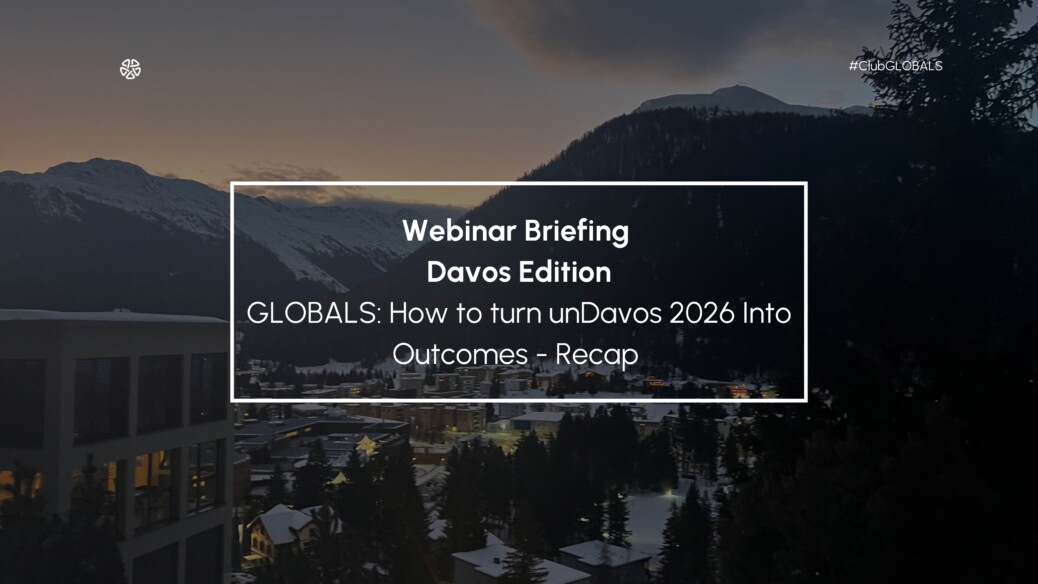
How to Turn Davos 2026 Into Outcomes: The GLOBALS Briefing Recap
The real Davos: it’s not one event, it’s 26 parallel “cities”
One of the most useful reframes from the session came early: Davos isn’t a single conference, it’s an operating system.
Alexander Widegren (Global Conversations) broke it down simply: expect a heavy density of events every day, with the rhythm of the week changing as it unfolds. Early days set the tone; mid-week is where relationships deepen and the highest-profile leaders arrive. (If you’ve been, you know this is exactly how the town feels.)
The practical implication
If you show up treating Davos like a normal conference, “I’ll just network and see what happens”, you’ll likely leave with:
-
a camera roll of hotel lobbies,
-
a stack of business cards,
-
and no narrative for what it did for your company.
The better approach: treat Davos like a campaign.
1) John Werner on “The Dome”: compressing a week of tech into one day
John Werner (Link Ventures / Imagination in Action) shared a concept that feels tailor-made for the Davos chaos: a single massive venue designed to reduce friction for people who don’t have time to chase 12 different side events across town.
Key highlights he shared:
- A 56,000 sq ft dome (one of the largest Davos venues) programmed as an all-in-one destination.
- Partnerships with top AI labs including MIT CSAIL and Stanford HAI.
- Programming built around multiple “intelligence” lenses (societal, embodied, planetary), aiming to answer the bigger question: what does this AI moment mean for the world, practically, ethically, economically?
- A VIP dinner the night before, and a big ambition: create a space where people don’t just consume panels, they interact, move, debate, record podcasts, and meet the right people.
Why it matters: In Davos, logistics can kill value. A concentrated, curated venue flips the game: fewer transfers, fewer dead hours, more high-quality collisions.
2) Alexander Widegren’s navigation framework: “wristbands, tracks, and timing”
Alexander’s most tactical point was also the most relatable: Davos has a language barrier, and not just German. It’s access logic.
He described the pain everyone knows: standing outside in the cold, spelling a name, hoping you’re on the list. His solution: structured access via wristbands, curating routes through lounges and tracks (crypto, family offices, etc.), and helping people stop wasting time at doors.
He also mapped the week’s “relationship physics”:
- Mon – Tue: orientation, intros, the tone is set
- Wed – Thu: deeper meetings, relationship-building, leaders arrive
- Fri: the “last 30-minute conversation” window, often where deals get unblocked
Why it matters: Davos rewards people who understand timing. The same message lands very differently on Monday than it does on Thursday.
3) Anya Braithwaite on DLD: the Munich warm-up with a shuttle to Davos
Anya (DLD Conference) positioned DLD Munich (Jan 15–17) as the ideal runway: cross-disciplinary, founder + scientist + artist energy, and a long-running obsession with the question:
How is AI changing life, politically, economically, culturally?
Two details stood out:
- DLD is intentionally invite-led and community-shaped, less “expo floor,” more curated conversations.
- The bridge is literal: a shuttle from Munich to Davos, making it easy to move from “deep thinking” into “Davos execution.”
Why it matters: If Davos is where ideas get turned into execution and visibility, DLD is often the clarity layer right before it, helping you pressure-test your thinking, sharpen your narrative, and arrive on the mountain with a tighter agenda and better conversations already queued up.
4) Jennifer de Broglie, founder of Abraham House:
The GLOBALS 2026 roadmap: where we’re going (and how to plug in)
After the Davos tactical briefing, Mario Paladini walked through the GLOBALS 2026 plan: a year designed around growth, visibility, and dealmaking, not random events for the sake of events, but a clear sequence of moments where the community can meet, collaborate, and compound relationships over time.
GLOBALS On Tour → Barcelona (GSTF26)
The deck frames Davos as the “last stop” before the next peak moment: GSTF26 in Barcelona on March 1, 2026 (MWC warm-up). It also shows the Tour cadence that’s been building community city-by-city (examples listed include Malta, Berlin, Madrid, Munich, Valencia, Lisbon, and Davos), creating a runway of local momentum that ultimately converges in Barcelona with a much stronger network already in motion.
5) Emilio Corchado on Startup OLE Miami: the Americas gateway in the GLOBALS 2026 expansion
Emilio Corchado brought the “what’s next” energy by spotlighting Miami as the kickoff point for the GLOBALS On Tour: Americas momentum. His message was clear: if you’re looking to connect Europe with Latin America and the US, Miami is one of the most efficient places to do it—fast access to international operators, capital, and partners in a single ecosystem.
He invited the community to Startup OLE Miami on April 20–21, positioned at the start of Tech Week, with a scale that reflects the ambition: around 2,000 attendees and 300 exhibitors, hosted at the James L. Knight Center. The underlying theme matched the rest of the briefing: don’t just attend, show up with intent, book the right meetings early, and use the Tour as a relationship runway that ultimately converges at the GLOBALS peak moments.
4) Katja Mulder on GITEX Europe: matchmaking as infrastructure (not a side feature)
Katja (Dubai World Trade Center / GITEX Europe) shared the most “operator” insight of the session: matchmaking isn’t a feature, it’s infrastructure. What she emphasized:
- GITEX Europe’s Berlin edition (June 30–July 1) is built around human-led concierge matchmaking, before the event, the team learns who wants to meet whom, and helps both sides prepare.
- The Supernova Challenge pitch competition includes a €100,000 equity-free prize.
- Their thesis: put the right people in the right room, and business happens, but only if the connection is intentional.
Why it matters for Davos too: The pattern: The winners aren’t the loudest. They’re the best prepared and best connected before they arrive.
Ambassador Program: local touch, global reach
A core pillar for 2026 and beyond is the GLOBALS Ambassador Program, aligned to a four-year expansion plan:
- Europe (2025) → Americas (2026) → Asia + Middle East (2027) → Africa + Australia (2028)
- The goal: empower local leaders to curate meetups, spotlight founders, and connect partners across a global network.
GSTF26: “Celebrating Growth” (festival format)
GSTF26 is positioned as a one-day festival experience with: exhibitor area, conferences + workshops, networking sessions, food & beverage, after party + activations, pitch competition! And the audience focus is explicit: C-level executives, VPs, directors, and tech leaders across SaaS, e-commerce, finance, telco, healthcare, marketing, and edtech.
What to do next (based on your Davos goal)
If your priority is maximizing high-signal conversations fast, take John Werner’s approach: pick one or two “hub” venues and anchor your day around them, instead of bouncing across town and losing time to logistics.
If you want to stop wasting time at doors, follow Alexander Widegren’s playbook: get clear on access logic (badges, lists, wristbands), and plan your routes so you’re not burning your best hours standing outside in the cold.
If you need to sharpen your thinking before Davos, Anya Braithwaite’s DLD angle is the move: use Munich as a pre-Davos clarity sprint, tight conversations, strong perspectives, and a better narrative before the mountain.
If your goal is to turn networking into pipeline, take Katja Mulder’s lesson from GITEX Europe: treat matchmaking as pre-work, not luck onsite, when the right people are put in the right room with context, business happens.
And if you’re thinking beyond the week, toward long-tail visibility, Katharine Christian’s Financial Times lens matters: package your presence into content and amplification so Davos doesn’t disappear the moment you fly home.
One more thing: Alexander didn’t just talk strategy, he also shared the most practical Davos “tips & tricks” (prep, gear, surviving the conditions, and how to move through the week smartly), which is exactly the kind of detail that saves you time and energy in the real world.
Pitfalls we see every year (and how to avoid them)
- FOMO scheduling: trying to attend everything guarantees you attend nothing properly.
Fix: pick 2–3 outcomes (investor intros, enterprise pipeline, recruiting, partnerships) and let that filter your calendar. - Badge confusion: not understanding access tiers leads to wasted hours.
Fix: map your access early and build a “secure zone” plan. - No narrative: meeting people without a clear story makes you forgettable.
Fix: arrive with a 1-sentence positioning line + a 2-minute “why now” story. - Underestimating the environment: Davos is physically demanding (weather + walking + logistics).
Fix: pack and plan like an operator (this is where Alex’s tips were gold).
What’s different about Davos 2026 (the signal beneath the noise)
Based on what our guests are building, Davos 2026 is shaping up around three macro-themes:
- AI moves from hype to consequence – shifting from “what can models do?” to “what should we deploy, and how?”
- Experience-based convening – domes, music resets, curated dinners, fewer generic panels
- Matchmaking as a competitive advantage – the best networks operationalize introductions, they don’t improvise them
Actionable takeaways (steal this checklist)
- Write down 3 measurable outcomes (not “networking”).
- Pick two anchor venues (one content hub, one meeting hub).
- Pre-book 10 meetings and leave 20–30% for serendipity.
- Decide your content plan (1 podcast slot, 3 short clips, 1 post-event debrief).
- If you want GLOBALS proximity and support, plug into the private group + delegation mechanics referenced in the roadmap deck.
- Put GSTF26 (Barcelona, March 1, 2026) on the calendar now.
Closing: Davos is a week – GLOBALS is the system around it
The big idea of the briefing wasn’t “come to Davos.” It was: don’t do Davos alone, and don’t do it randomly. The week moves fast, the rooms change by the hour, and the difference between “busy” and “productive” is usually your preparation, and who you’re plugged into.
Whether you’re navigating the Magic Mountain, building your 2026 partnership pipeline, or aiming for visibility in the right circles, the GLOBALS approach stays consistent: curation over chaos, outcomes over optics, and community as growth infrastructure, before, during, and after the week.
If you want to be part of the next delegation, explore speaking opportunities, or activate through the Ambassador Program, this is the moment to raise your hand, and start turning Davos conversations into 2026 momentum.